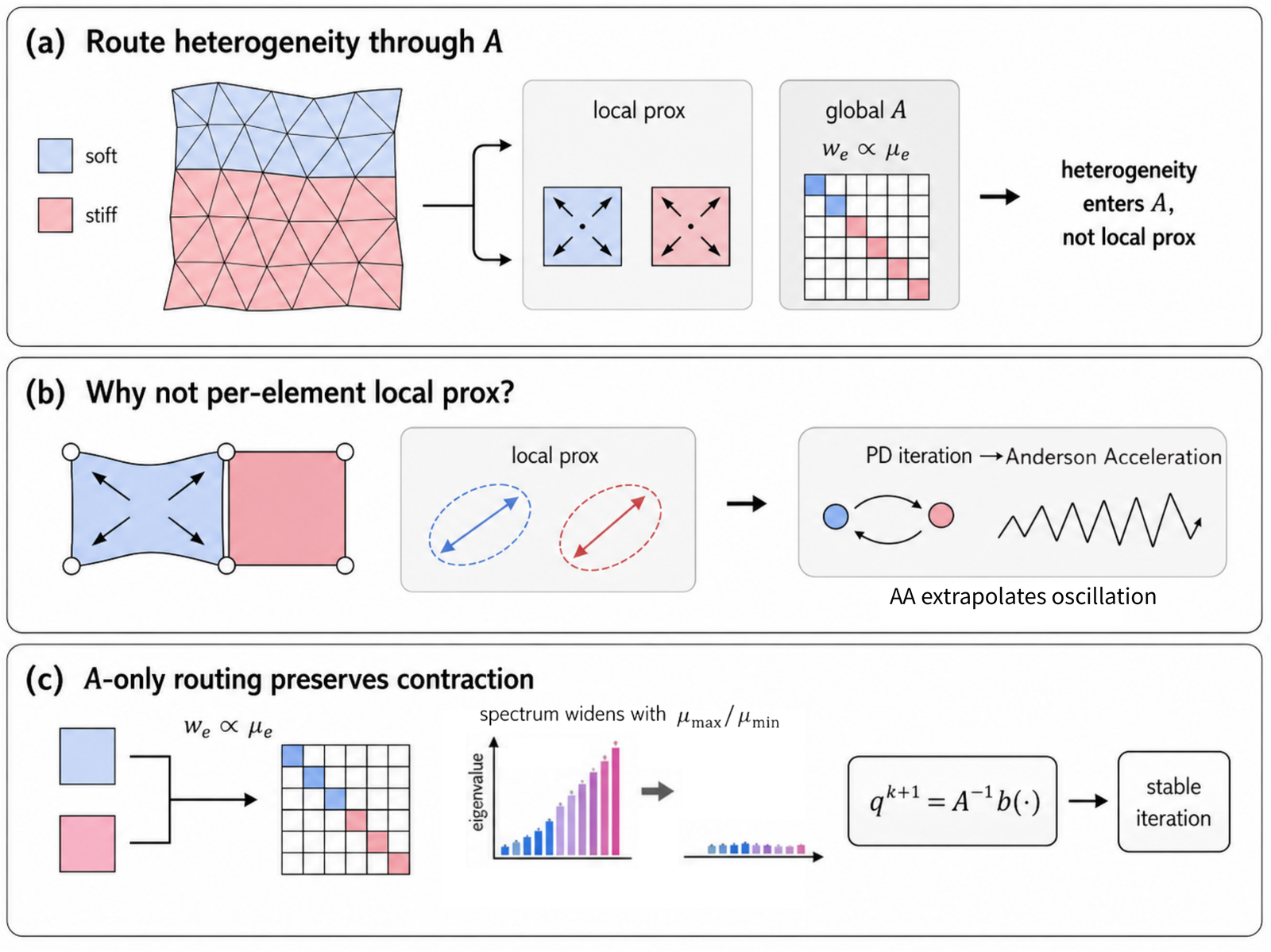
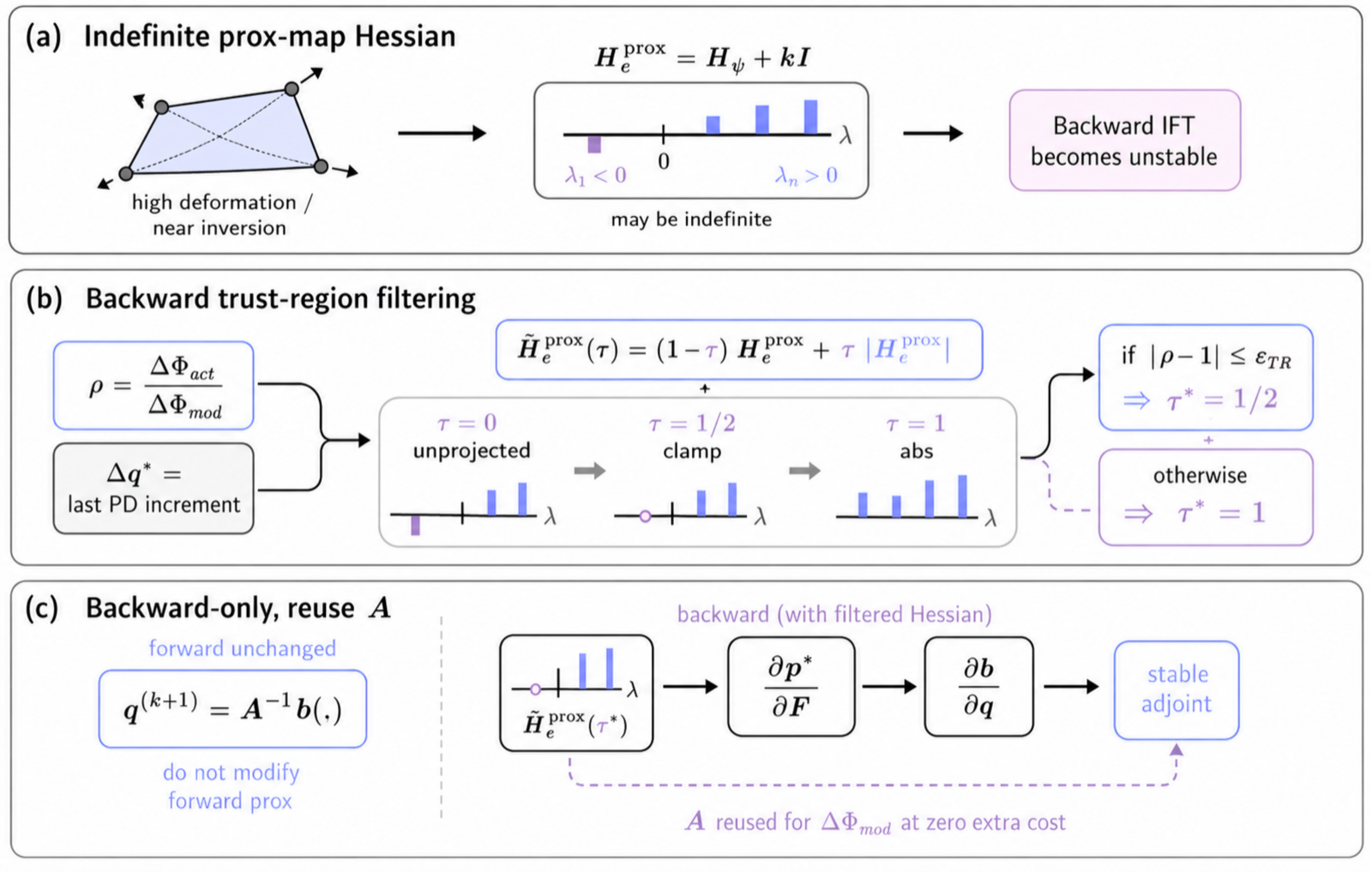
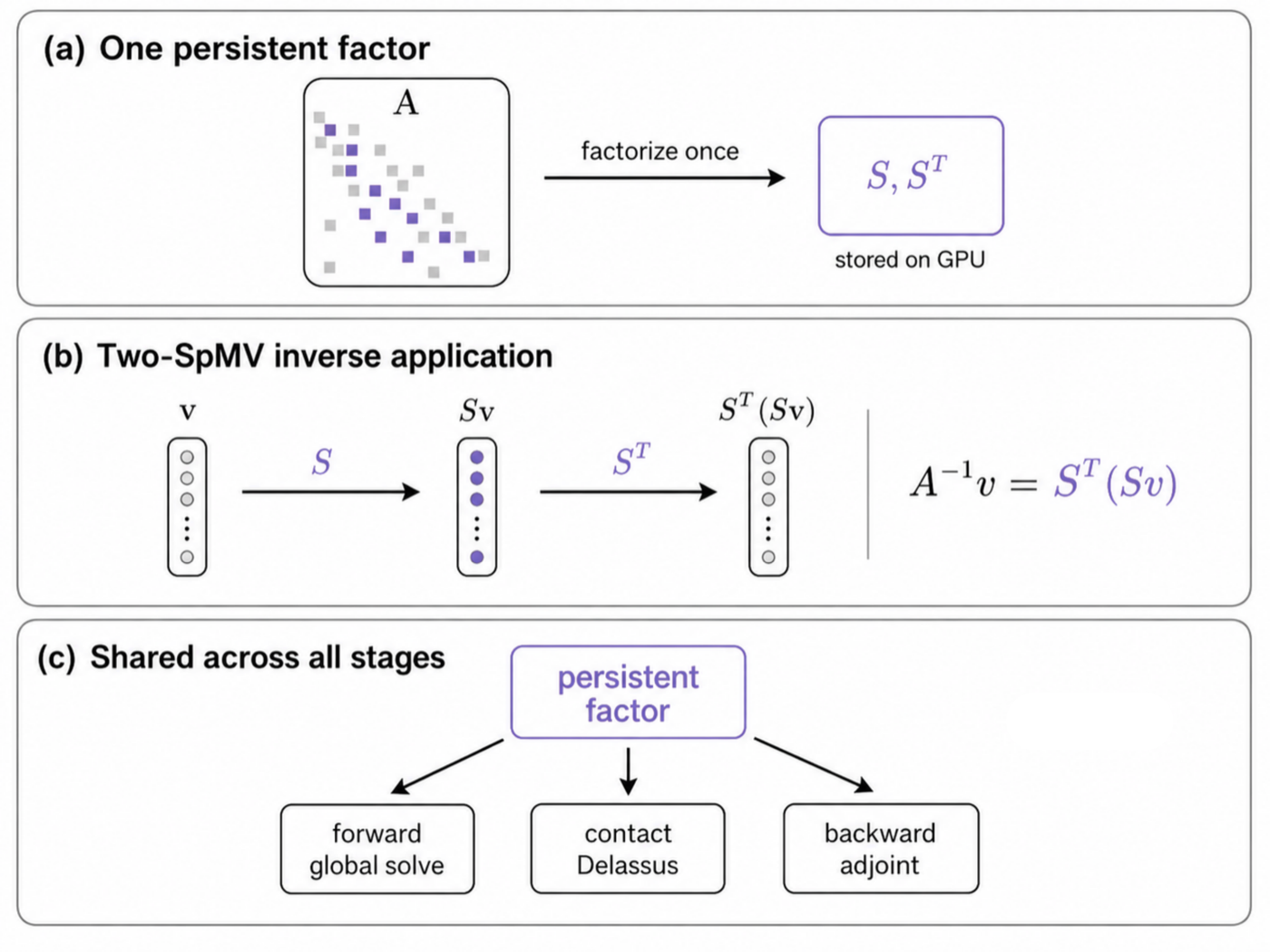
Differentiable simulation of soft bodies is a foundation for system identification, trajectory optimization, and Real2Sim transfer. Yet, existing methods such as the differentiable Projective Dynamics (DiffPD) struggle when faced with heterogeneous materials with extreme stiffness contrasts, hyperelasticity under large deformations, and contact-rich interactions, which are common scenarios in the real world. We present DiffPhD, a unified GPU-accelerated differentiable Projective Dynamics framework for heterogeneous materials that tackles these intertwined challenges simultaneously. Our key insight is a careful integration of: (i) stiffness-aware projective weights to embed heterogeneity into the global system; (ii) trust-region eigenvalue filtering lifted to the backward pass for stable hyperelastic gradients and a type-II Anderson Acceleration scheme with dual-gate convergence to stabilize forward iteration under large stiffness contrasts; and (iii) a unified GPU pipeline that reuses a single sparse factor across forward, backward, and contact computations, with stiffness-amplified Rayleigh damping folded into the same factor for heterogeneity-aware dissipation at zero recurring cost. DiffPhD delivers analytic adjoints—machine-precision on the elastic path, bounded and quantified under contact—with up to an order-of-magnitude speedup over prior differentiable solvers. Crucially, this speedup does not come at the cost of stability: DiffPhD remains convergent on stiffness contrasts up to 100× where prior PD solvers degrade. This unlocks end-to-end gradient-based optimization on regimes previously bottlenecked by either solver fragility or per-iteration cost—shell–joint composite creatures, soft characters wielding stiff weapons, and soft-gripper robotic manipulation—all handled within a single forward–backward pass.
DiffPhD's design rests on one observation: Projective Dynamics' global stiffness matrix A is the shared backbone of every expensive operation—forward global step, Delassus contact compliance, backward adjoint—so the solver is organized around making A cheap to invert and robust under contrast. Heterogeneity is routed structurally through stiffness-aware projective weights baked directly into the global matrix; a trust-region filter is lifted onto the proximal-map Hessian in the backward pass to yield accurate Neo-Hookean gradients at high Poisson's ratios and large deformations; and a single persistent sparse-inverse factor is reused across forward, backward, and frictional-contact computations for an order-of-magnitude wall-clock improvement.
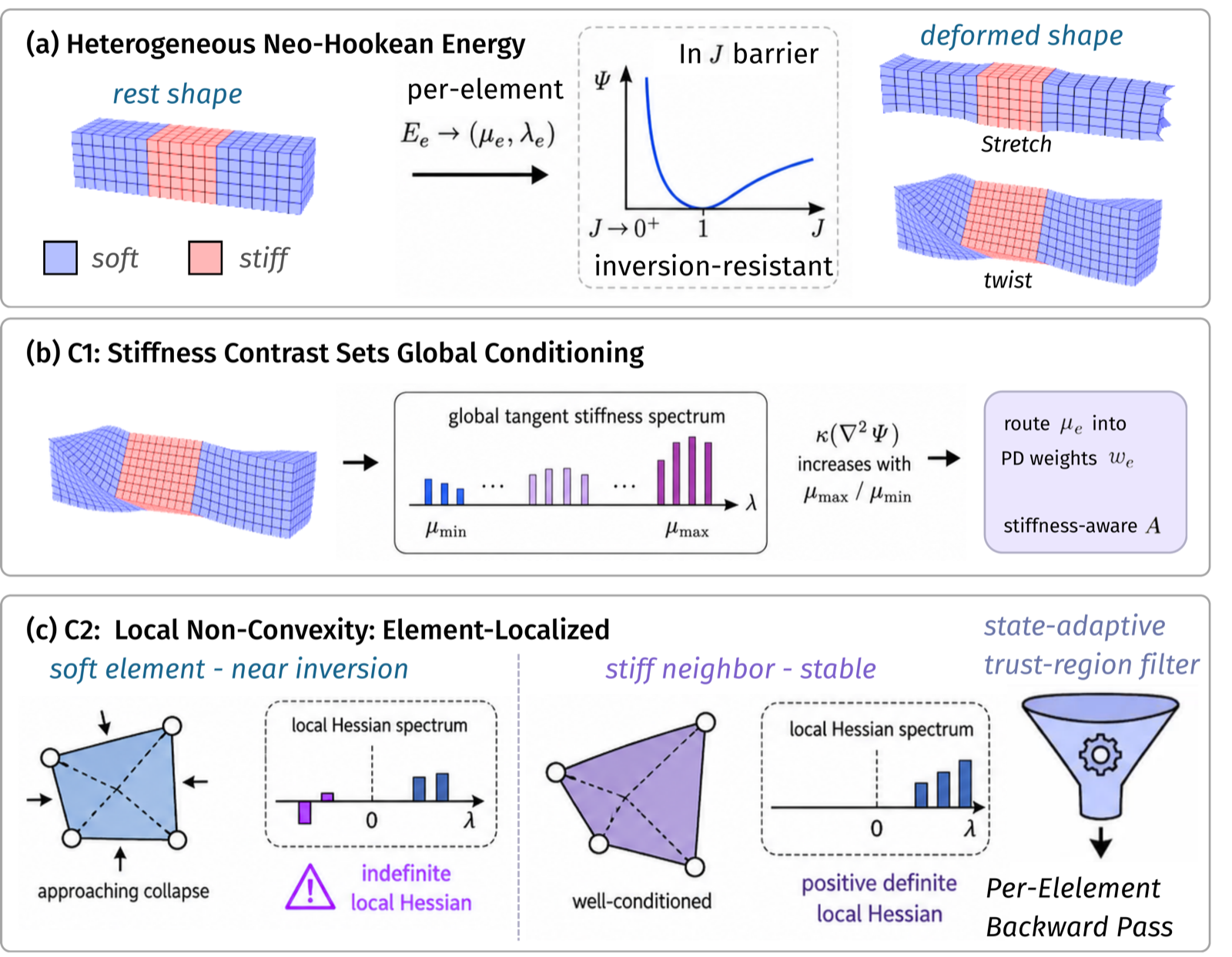
We validate DiffPhD on heterogeneous, hyperelastic, contact-rich benchmarks spanning forward simulation stability, differentiable inverse problems (system identification, initial-state and trajectory optimization), and Real2Sim robotic manipulation.
@article{lai2026diffphd,
author = {Lai, Shih-Yu and Tien, Sung-Han and Huang, Jui-I and Tseng, Yen-Chen and Chiu, Yi-Ting and Luo, Siyuan and Zeng, Ziqiu and Shi, Fan and Chen, Peter Yichen and Liu, Tiantian and Liu, Yu-Lun and Chen, Bing-Yu},
title = {DiffPhD: A Unified Differentiable Solver for Projective Heterogeneous Materials in Elastodynamics with Contact-Rich GPU-Acceleration},
journal = {arXiv preprint arXiv:2605.14526},
year = {2026}
}